

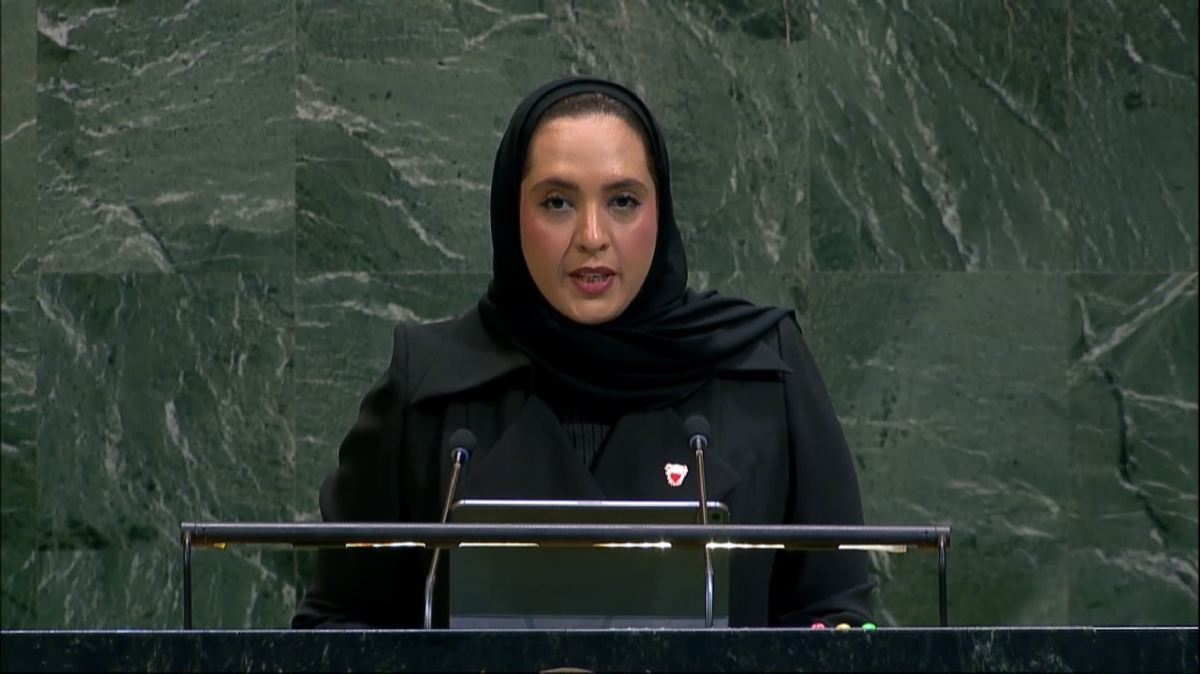
Her Excellency Ms. Amna bint Ahmed Al Rumaihi, Minister of Housing and Urban Planning, headed the delegation of the Kingdom of Bahrain participating in the high-level meeting for the mid-term review of the implementation of the New Urban Agenda, which was held at the United Nations Headquarters in New York City, with the participation of ministers, senior officials and representatives of Member States, to discuss the progress made in implementing the New Urban Agenda since its adoption in 2016, review national experiences, and enhance international commitment to accelerate its implementation over the next decade To support the achievement of the Sustainable Development Goals by 2030, and to complete the goals of the New Urban Agenda by 2036.
Minister Amna Al Rumaihi delivered the Kingdom's speech during the meeting, during which she stressed that the Kingdom views the New Urban Agenda as a practical framework for developing national policies, enhancing the quality of life, and building more sustainable, inclusive and resilient cities, in line with the eleventh goal of the Sustainable Development Goals, which calls for making cities and human settlements inclusive, safe, resilient and sustainable.
The Minister explained that the Kingdom of Bahrain has been able to transform the principles of the New Urban Agenda into integrated national policies and programmes, based on the high royal directives of His Majesty King Hamad bin Isa Al Khalifa, King of the Kingdom of Bahrain, may God protect and preserve him, which made people the focus of development and quality of life a main goal of various national plans and projects, and on the directives of the government headed by His Royal Highness Prince Salman bin Hamad Al Khalifa The Crown Prince and Prime Minister, may God protect him, by accelerating the implementation of urban and housing projects, most notably the program to establish 50,000 housing units, as a national program to build integrated urban communities that provide housing, services and economic opportunities, and support the achievement of the goals of the New Urban Agenda.
The Minister of Housing and Urban Planning added that achieving sustainable urban development begins with integrated urban planning, which the Kingdom has given top priority to, as it has completed planning 96 unplanned areas with a total area of approximately 84 square kilometers, while completing infrastructure requirements and allocating the necessary land for public facilities and services, which enhances land use efficiency, raises the quality of the urban environment, and keeps pace with population and economic growth according to sustainable planning foundations.
Minister Amna Al Rumaihi stressed that the Kingdom pays special attention to employing the concept of "future cities" in planning and developing housing cities, based on a development vision that places people at the heart of the urban process, and considers quality of life a key indicator of the success of urban development.
She explained that this trend is reflected in the projects of Salman City, Khalifa City, Al Hidd Housing City, Sitra Housing City, and Al Ramli Suburb, which were designed as integrated urban communities that include residential units in addition to schools, health centers, municipal services, cultural, sports, and recreational facilities, and public and green spaces, which enhances community cohesion, provides an integrated urban environment that supports family stability, improves the quality of life, and keeps pace with the best international practices in sustainable urban planning.
Minister Al Rumaihi pointed out that the Kingdom's vision for urban development is not limited to establishing new cities, but also extends to preserving the urban and cultural identity as one of the pillars of sustainable development, explaining that the Kingdom is implementing projects to develop the city of Muharraq and redevelop the historical area of Manama Souq, in implementation of the royal high order to preserve the historical and cultural identity of Bahrain's buildings and cities, which embodies an integrated model that combines infrastructure development and rehabilitation of heritage buildings Improving the urban landscape, enhancing the quality of life, while preserving the historical and cultural character of cities.
The Minister also reviewed national efforts aimed at enhancing the efficiency of urban policy implementation, through expanding partnerships with the private sector, developing housing financing programs, launching national initiatives to develop government lands, in addition to employing digital transformation and spatial data to support urban planning and decision-making, which contributes to raising the efficiency of project implementation, achieving optimal use of resources, and enhancing the sustainability of cities.
Minister Amna Al Rumaihi stressed that the next stage requires continuing to develop urban policies in a more integrated manner, by enhancing innovation, benefiting from modern technologies, expanding partnerships, and raising the efficiency of urban planning, enabling cities to respond flexibly to future challenges, and enhancing their ability to achieve economic, social and environmental development in a balanced manner.
At the conclusion of her speech, the Minister reaffirmed the Kingdom of Bahrain's commitment to continuing to work with the international community, enhancing cooperation and exchanging experiences and best practices, and supporting the efforts led by the United Nations Human Settlements Programme, which contributes to accelerating the implementation of the New Urban Agenda, achieving its goals, and building more sustainable, inclusive and resilient cities, enhancing the quality of life and achieving sustainable development for current and future generations.
 Virtual Assistant